


China Quality Daily Two Sessions Express | Li Changdong: Proposal to Amplify "China's Voice" in International Standards for Power Battery Recycling
-

Release time:2026-03-15
-

Author:Brunp Recycling
During this year’s Two Sessions, Li Changdong, Deputy to the National People’s Congress (NPC), Chairman & President of Brunp Recycling, focused on power battery recycling and put forward proposals to accelerate participation in the formulation of international standards and promote the establishment of a fair and rational global standard system for power battery recycling. His proposals were covered by China Quality Daily.
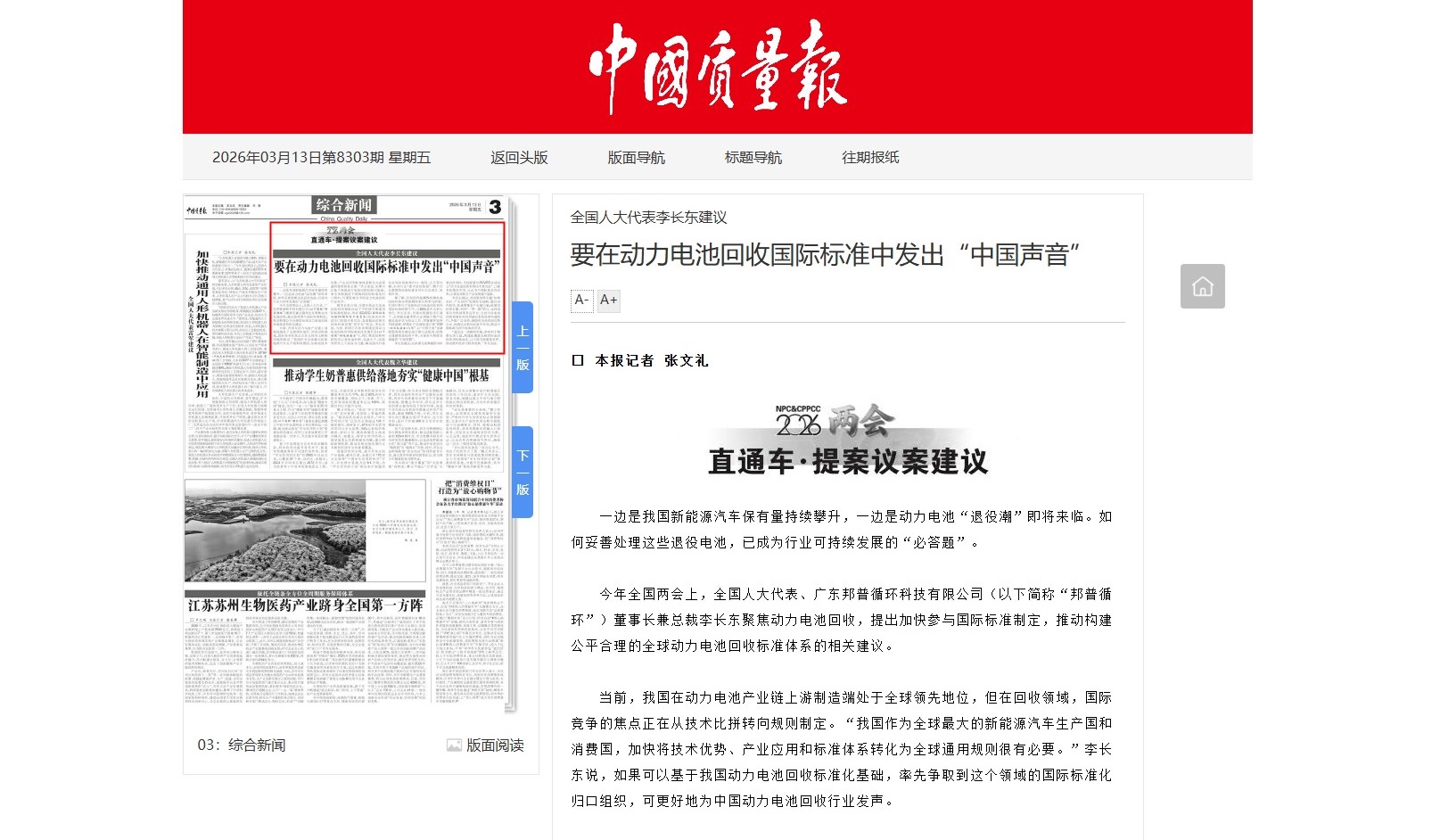
China Quality Daily (March 13, 2026 | Page 03)
Full report from China Quality Daily
▼
NPC Deputy Li Changdong Proposes
To Amplify "China's Voice" in International Standards for Power Battery Recycling
By Zhang Wenli
China Quality Daily (March 13, 2026 | Page 03)
While China’s inventory of new energy vehicles continues to surge, a “retirement wave” for power batteries is imminent. Properly managing these retired batteries has become an “essential task” for the industry’s sustainable development.
At this year’s National Two Sessions, Li Changdong, Deputy to the National People’s Congress and Chairman & President of Guangdong Brunp Recycling Technology Co., Ltd. (referred to as “Brunp Recycling”), focused on power battery recycling and put forward proposals to accelerate participation in the formulation of international standards and promote the establishment of a fair and reasonable global standard system for power battery recycling.
Currently, China holds a leading global position in the upstream manufacturing segment of the power battery industrial chain. However, in the recycling sector, the focus of international competition is shifting from technological rivalry to rule-making. “As the world’s largest producer and consumer of new energy vehicles, it is essential for China to accelerate the translation of its technological advantages, industrial applications and standard system into globally applicable rules,” Li Changdong said. If China can, building on its standardized foundation for power battery recycling, take the lead in securing the international standardization technical committee for this field, it can better amplify the voice of China’s power battery recycling industry.
According to Li Changdong, although the formulation of international standards for individual detailed aspects in the field of power battery recycling has been launched, no dedicated technical committee has been established at the ISO/IEC (International Organization for Standardization/International Electrotechnical Commission) level, and the relevant recycling standards proposed by various countries are in a “fragmented” state. Li Changdong said that at present, China is accelerating the preparation for the establishment of the National Technical Committee for Standardization of Power Battery Recycling (referred to as the “Recycling Standardization Committee”), which will gather forces from universities, scientific research institutes, as well as upstream and downstream parties such as battery materials, battery manufacturing and recycling, to solve problems such as the jurisdiction, planning and overlapping of existing recycling standards in China, and bridge the “hidden gaps” of the industry. The entire industry expects the Recycling Standardization Committee to be officially established and play its role at an early date.
It is learned that over 80% of China’s current lithium battery recycling standards have been led or developed by Brunp Recycling. The company has also participated in the formulation of all national standards for power battery recycling, serving as the lead unit for 60% of them. Li Changdong emphasized that under the guidance of a green and low-carbon economy, a growing number of global enterprises are actively conducting product carbon footprint assessments and verifications. Adhering to scientific and technological innovation, Brunp Recycling has developed the “ICM (Integrated Carbon-right Method) Scheme” for product carbon footprint calculation. This “China solution” addresses the bottlenecks in existing carbon footprint calculation methods such as those adopted by the EU, advances equity in global carbon emissions rights, and provides “China wisdom” for green and sustainable development.
Li Changdong proposes that while accelerating the establishment of the domestic standardization committee, China should promptly apply to ISO/IEC for the establishment of a “Technical Committee for power Battery Recycling”, with its secretariat based in China. This will pave the way for Chinese standards to go global and lead the development of relevant industries worldwide.
Li Changdong recommends that China accelerate the implementation of an internationalization strategy of “standards first, industrial coordination”. This involves strengthening domestic coordination to rapidly mobilize resources across the entire industrial chain; expanding international partnerships by leveraging multilateral platforms such as the Belt and Road Initiative and the BRICS cooperation mechanism to actively communicate and collaborate with countries sharing common interests in battery recycling and secure broad support; encouraging and supporting Chinese competitive enterprises, testing and certification institutions to establish overseas presence, promoting mutual recognition between Chinese and foreign standards.
“The implementation of this strategy will help mobilize global resources to build a worldwide standard system for battery recycling, enabling China’s solutions to benefit the world and driving the sustainable development of the circular economy,” Li Changdong said.
Share


