


People’s Daily Two Sessions “Guangdong Moment” | Li Changdong: Propose “Full-Chain Integration” of Power Battery Recycling into Chemical Parks
-

Release time:2026-03-13
-

Author:Brunp Recycling
During the Two Sessions, Li Changdong, NPC Deputy, Chairman and President of Guangdong Brunp Recycling Technology Co., Ltd., stated that power battery recycling has entered a stage of high-quality development. He proposed advancing the “full-chain integration” model into chemical parks to guide the rational layout, rational investment and efficient operation of the national power battery recycling industry. In response, People’s Daily published a follow-up report:
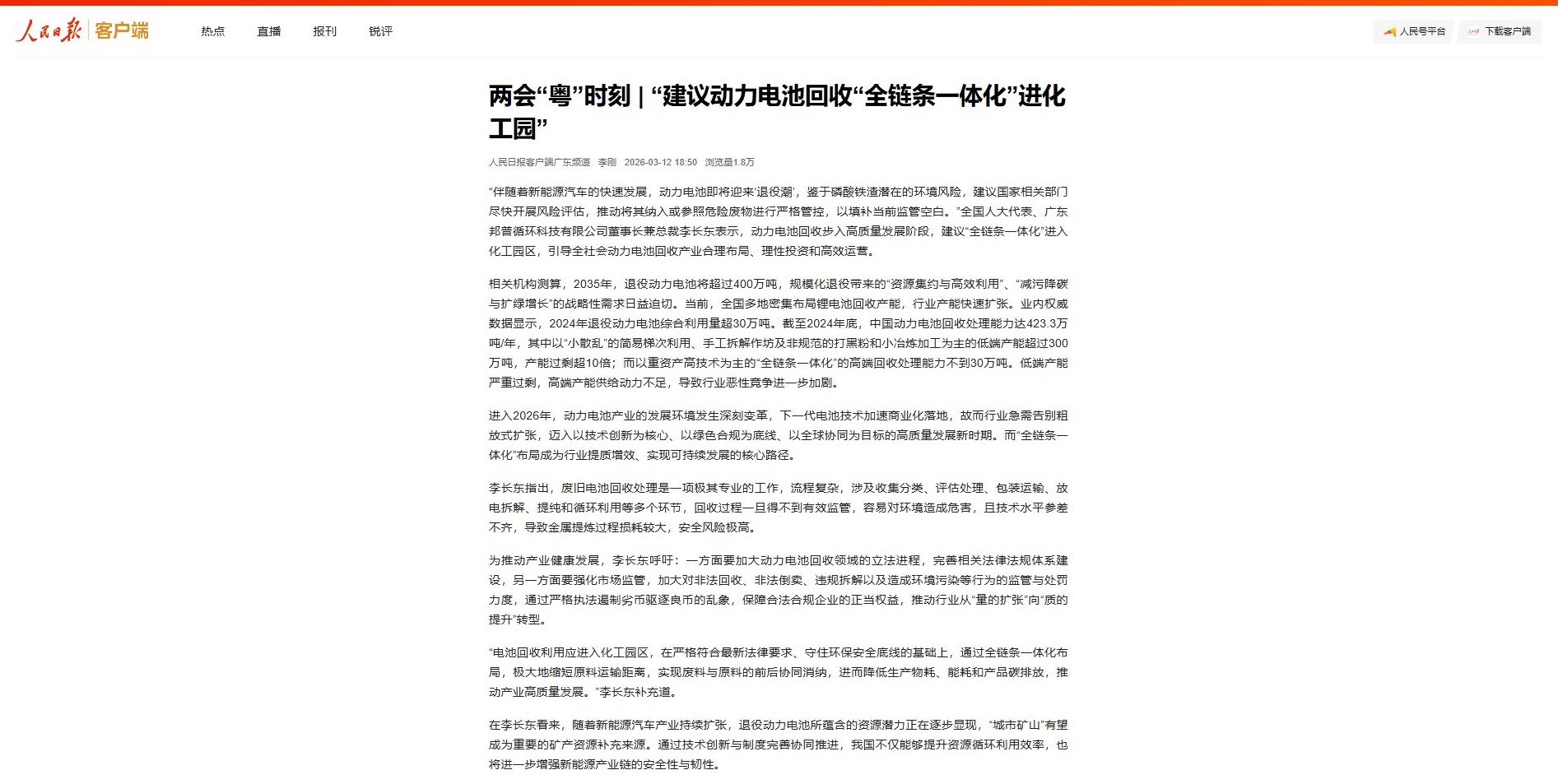
“With the rapid development of new energy vehicles, power batteries are about to face a ‘retirement wave’. Given the potential environmental risks of iron phosphate slag, we recommend that relevant national departments conduct risk assessments as soon as possible and promote its inclusion in or strict control hazardous waste to fill the current regulatory gap,” said Li Changdong, NPC Deputy, Chairman and President of Guangdong Brunp Recycling Technology Co., Ltd. He noted that power battery recycling has entered a high-quality development phase and proposed “full-chain integration” into chemical parks to drive rational layout, prudent investment and efficient operation across the industry.
According to estimates by relevant institutions, retired power batteries will exceed 4 million tons by 2035. Large-scale retirement is creating an increasingly urgent strategic demand for “resource conservation and efficient utilization” as well as “pollution reduction, carbon abatement, green expansion and growth”. Currently, many regions across China are aggressively deploying lithium battery recycling capacity, leading to rapid industry expansion. Authoritative industry data shows that the comprehensive utilization volume of retired power batteries exceeded 300,000 tons in 2024.
By the end of 2024, China’s power battery recycling and processing capacity reached 4.233 million tons per year. Of this, low-end capacity—dominated by fragmented and informal practices such as simple echelon utilization, manual dismantling workshops, unregulated black powder production and small-scale smelting—exceeded 3 million tons, representing over 10 times overcapacity. In contrast, high-end recycling capacity focused on asset-heavy, technology-intensive “full-chain integration” is less than 300,000 tons. Severe overcapacity at the low end and insufficient supply of high-end capacity have intensified vicious competition in the industry.
Entering 2026, the development environment of the power battery industry has undergone profound changes. Next-generation battery technologies are accelerating commercialization, prompting the industry to abandon extensive expansion and embrace a new era of high-quality development centered on technological innovation, green compliance as the bottom line, and global collaboration as the goal. The “full-chain integration” model has become the core path for the industry to improve quality, increase efficiency and achieve sustainable development.
Li Changdong emphasized that waste battery recycling and processing is a highly specialized and complex process involving multiple links: collection and classification, evaluation and treatment, packaging and transportation, discharge and dismantling, purification and recycling. Without effective supervision, recycling poses environmental risks. Uneven technical standards also lead to significant metal refining losses and high safety hazards.
To promote healthy industrial development, Li Changdong called for accelerated legislation in power battery recycling and improved laws and regulations. He also urged strengthened market supervision and stricter penalties for illegal recycling, resale, dismantling and environmental pollution. Strict law enforcement will curb the “bad money driving out good” phenomenon, protect the legitimate rights and interests of compliant enterprises, and drive the industry’s transition from “quantity expansion” to “quality improvement”.
“Battery recycling should be located in chemical parks. While strictly complying with the latest legal requirements and maintaining environmental and safety standards, a full-chain integrated layout will significantly shorten raw material transportation distances, enable coordinated waste and raw material utilization, reduce production material and energy consumption as well as product carbon emissions, and promote high-quality industrial development,” Li Changdong added.
In Li Changdong’s view, as the new energy vehicle industry continues to expand, the resource potential of retired power batteries is increasingly evident. “Urban mines” are expected to become an important supplementary source of mineral resources. Through coordinated technological innovation and institutional improvement, China can enhance resource recycling efficiency and further strengthen the safety and resilience of its new energy industrial chain.
It is understood that to prepare for the upcoming battery retirement wave, Brunp Recycling has built a globally coordinated production capacity layout centered on large domestic bases. By 2030, its planned total recycling capacity will exceed 1 million tons, including over 500,000 tons for lithium iron phosphate batteries. Through proactive layout, the company has initially established full-chain integrated processing capabilities for both ternary and lithium iron phosphate battery technologies. This demonstrates the commercial viability of the model and provides a reference for the industry.
-
Previous:
Brunp Recycling Holds Meeting to Convey and Implement the Spirit of General Secretary Xi Jinping’s Important Speeches and the National Two Sessions
-
Next:
People’s Daily Frontpage | NPC Deputy Li Changdong on Independent Innovation in Science and Technology — Stand Firm in Pursuing Confirmed Development Goals
Share


